Friday, September 25, 2009

Sachin Tendulkar scored 200

Indians dedicate win to Tendulkar


Sachin Tendulkar
Tendulkar holds the World Cup trophy aloft outside the Taj hotel in Mumbai.


Sachin Tendulkar of India is chaired on a lap of honor after India's victory over Sri Lanka in the 2011 ICC World Cup Final between India and Sri Lanka played at Wankhede Stadium on April 2, 2011 in Mumbai, India.

Sachin Tendulkar make crosses 18,000 runs.

Sachin Tendulkar has become the first batsman to score 50 centuries in Test cricket.

India's Sachin Tendulkar hits 50th Test century in first Test against South Africa
Thanking his lucky stars: Sachin Tendulkar raises his bat, celebrating his 50th Test.

The 37 year-old achieved the feat, and also passed 14,500 runs, as India battled to make South Africa bat again in the first Test in Centurion.
Tendulkar scored 107 not out.

Tendulkar moved to 95 by driving Paul Harris for six, then edged towards 100, ultimately reaching the milestone in his 175th Test with a single off Dale Steyn.

The 37 year-old achieved the feat, and also passed 14,500 runs, as India battled to make South Africa bat again in the first Test in Centurion.

Tendulkar moved to 95 by driving Paul Harris for six, then edged towards 100, ultimately reaching the milestone in his 175th Test with a single off Dale Steyn.


Sachin Tendulkar Highest ODI Score Sachin Tendulkar 200 Runs Tendulkar 200 Runs India vs South Africa India Cricket India’s Sachin Tendulkar Equals Highest ODI Score of 200 Runs Sachin Tendulkar Break Saeed Anwar’s Record World Record Sachin Hit Double Century In ODI Sachin 200 Runs Against South Africa Sachin Tendulkar Hit Double Century In ODI Sachin Tendulkar Hit Double Century In ODI Sachin Can Get 200 In ODIs


Profile

One of the greatest players to have ever played the game, Sachin Ramesh Tendulkar has been the greatest icon of world cricket for almost two decades now. Ever since his debut way back in 1989, he displayed exemplary skills when at the crease and was immediately hailed as the next genius. Sachin did not disappoint anyone and cruised his way into the record books with each knock. The mid-90s saw him peak and every opposition feared the ‘Little Master’. His batting is based on simple principles and he does not possess any trademark stroke, although the straight drive comes close. Tendulkar's triumph has been his ability to adapt to situations, surfaces, oppositions and emerging victorious. He can score all around the wicket, off both front foot and back, and has made runs in all parts of the world. Don Bradman confessed that Tendulkar reminded him of himself and this perhaps speaks volumes of the latter's greatness.With infinite records to his name, Sachin is widely regarded as one of the greatest batsmen in the history of cricket. Each time he comes to bat, he carries the expectation of millions of people with him and comes good more often than not, which only reinforces the enormity of this genius. His opening partnerships with Sourav Ganguly marked one of the most successful phases of Indian cricket. Tendulkar is one of the very few Indian players to never be dropped from the team and his consistency in Tests and ODIs is remarkable.He has suffered a few injuries but over the years India has developed firebrand cricketers like Virender Sehwag, MS Dhoni and Yuvraj Singh who have borne the burden of Tendulkar’s former responsibility. But Tendulkar never takes things for granted and each passing year, he outdoes himself but creating another record. He already holds the record for most runs in Tests and ODIs and most centuries in both forms of the game. He deliberately omits himself from Twenty20 Internationals and that may have been his biggest regret as a young Indian team won the inaugural World Twenty20. As age catches up with him, he picks and chooses series he wishes to participate in. His ultimate goal is to sign off with a World Cup victory, which millions of Indians are hoping will come in his home-town India, in 2011.


Sachin Tendulkar scored 200 runs in second ODI against South Africa today at Gwalior. Sachin is first cricketer to score double century in ODI matches. It was his 411th ODI match. To score 200 runs, Tendulkar played 147 balls. With this Sachin creates World record for highest runs and also only player to score double century in ODI matches.
Sachin 25 boundaries and three sixes. Before this the highest score of Sachin in ODI was 187 runs. He took 56 singles and 13 double runs in his historic inning.
With this Sachin become highest run scorer in ODI format. Sachin broke the record of Saeed Anwar of 194 runs which was against India. Imporant part of Sachin inning was that he did not use any runner where as Saeed AnwarSachin Tendulkar, who plays for India, scored 200 not out in today's game against South Africa, beating his own personal best of 186 not out.

Current ODI batting records:

  • 200 not out: Sachin Tendulkar, India
  • 194 not out: Charles Coventry, Zimbabwe
  • 194: Saeed Anwar, Pakistan
  • 189 not out: Viv Richards, West Indies
  • 189: Sanath Jayasuriya, Sri Lanka
  • 188 not out:Gary Kirsten, South Africa


That's the record! He lunges forward to a full delivery outside off and deftly glides it down to third man, he pumps his fists as he completes the second run, he's now the highest run-scorer in Tests beating Lara's tally of 11,953, fireworks go up in the stadium, he gets a rousing standing ovation from the crowd and his team-mates, there's a brief hold up in play as the fireworks seem to last forever! All the Australians rush to congratulate him. The Australians are taking a breather, normal service has been disrupted, that's for sure! Incidentally, Lara overtook Allan Border's record against Australia as well, in Adelaide in


Sachin Tendulkar's first interview in 1989


70 of the Records Held by Sachin Tendulkar


1. Highest Run scorer in the ODI
2. Most number of hundreds in the ODI 46
3. Most number of nineties in the ODI
4. Most number of man of the matches(56) in the ODI's
5. Most number of man of the series(14) in ODI's
6. Best average for man of the matches in ODI's
7. First Cricketer to pass 10000 run in the ODI
8. First Cricketer to pass 15000 run in the ODI
9. He is the highest run scorer in the world cup (1,796 at an average of 59.87 as on 20 March 2007)
10. Most number of the man of the matches in the world cup
11. Most number of runs 1996 world cup 523 runs in the 1996 Cricket World Cup at an average of 87.16
12. Most number of runs in the 2003 world cup 673 runs in 2003 Cricket World Cup, highest by any player in a single Cricket World Cup
13. He was Player of the World Cup Tournament in the 2003 Cricket World Cup.
14. Most number of Fifties in ODI's 93
15. Appeared in Most Number of ODI's 456
16. He is the only player to be in top 10 ICC ranking for 10 years.
17. Most number of 100's in test's 49.
18. He is one of the three batsmen to surpass 11,000 runs in Test cricket, and the first Indian to do so
19. He is thus far the only cricketer to receive the Rajiv Gandhi Khel Ratna, India's highest sporting honor
20. In 2003, Wisden rated Tendulkar as d No. 1 and Richards at No. 2 in all time Greatest ODI player
21. In 2002, Wisden rated him as the second greatest Test batsman after Sir Donald Bradman.
22. he was involved in unbroken 664-run partnership in a Harris Shield game in 1988 with friend and team mate Vinod Kambli,
23. Tendulkar is the only player to score a century in all three of his Ranji Trophy, Duleep Trophy and Irani Trophy debuts
24. In 1992, at the age of 19, Tendulkar became the first overseas born player to represent Yorkshire
25. Tendulkar has been granted the Rajiv Gandhi Khel Ratna, Arjuna Award and Padma Shri by Indian government. He is the only Indian cricketer to get all of them.
26. Tendulkar has scored over 1000 runs in a calendar year in ODI's 7 times
27. Tendulkar has scored 1894 runs in calendar year in ODI's most by any batsman
28. He is the highest earning cricketer in the world
29. He has the least percentage of the man of the matches awards won when team looses a match. Out of his 56 man of the match awards only 5 times India has lost.
30. Tendulkar most number man of match awards(10) against Australia
31. In August of 2003, Sachin Tendulkar was voted as the "Greatest Sportsman" of the country in the sport personalities category in the Best of India poll conducted by Zee News.
32. In November 2006, Time magazine named Tendulkar as one of the Asian Heroes.
33. In December 2006, he was named "Sports person of the Year
34. The current India Poised campaign run by The Times of India has nominated him as the Face of New India next to the likes of Amartya Sen and Mahatma Gandhi among others.
35. Tendulkar was the first batsman in history to score over 50 centuries in international cricket
36. Tendulkar was the first batsman in history to score over 93 centuries in international cricket:79 centuries
37. Has the most overall runs in cricket, (ODIs+Tests+Twenty20s), as of 30 June 2007 he had accumulated almost 26,000 runs overall.
38. Is second on the most number of runs in test cricket just after Brian Lara
39. Sachin Tendulkar with Sourav Ganguly hold the world record for the maximum number of runs scored by the opening partnership. They have put together 6,271 runs in 128 matches
40. The 20 century partnerships for opening pair with Sourav Ganguly is a world record
41. Sachin Tendulkar and Rahul Dravid hold the world record for the highest partnership in ODI matches when they scored 331 runs against New Zealand in 1999
42. Sachin Tendulkar has been involved in six 200 run partnerships in ODI matches - a record that he shares with Sourav Ganguly and Rahul Dravid
43. Most Centuries in a calendar year: 9 ODI centuries in 1998
44. Only player to have over 100 innings of 50+ runs (41 Centuries and 87 Fifties)(as of 18th Nov, 2007)
45. the only player ever to cross the 17,000 run marks IN ODI.
46. Sachin Tendulkar achieved the highest ever score in one-dayers, 200 RUNS in 147 BALLS, overtaking Saeed Anwar’s 13-year old, versus South Africa on 24/2/2010 ).
47. The score of 200* is listed the fifth highest score recorded in ODI matches
48. Tendulkar has scored over 1000 ODI runs against all major Cricketing nations.
49. Sachin was the fastest to reach 10,000 runs taking 259 innings and has the highest batting average among batsmen with over 10,000 ODI runs
50. Most number of Stadium Appearances: 90 different Grounds
51. Consecutive ODI Appearances: 185
52. On his debut, Sachin Tendulkar was the second youngest debutant in the world
53. When Tendulkar scored his maiden century in 1990, he was the second youngest to score a century
54. Tendulkar's record of five test centuries before he turned 20 is a current world record
55. Tendulkar holds the current record (217 against NZ in 1999/00 Season) for the highest score in Test cricket by an Indian when captaining the side
56. Tendulkar has scored centuries against all test playing nations.[7] He was the third batman to achieve the distinction after Steve Waugh and Gary Kirsten
57. Tendulkar has 4 seasons in test cricket with 1000 or more runs - 2002 (1392 runs), 1999 (1088 runs), 2001 (1003 runs) and 1997 (1000 runs).[6] Gavaskar is the only other Indian with four seasons of 1000+ runs
58. He is second most number of seasons with over 1000 runs in world.
59. On 3 January 2007 Sachin Tendulkar (5751) edged past Brian Lara's (5736) world record of runs scored in Tests away from home
60. Tendulkar and Brian Lara are the fastest to score 10,000 runs in Test cricket history. Both of them achieved this in 195 innings
61. Second Indian after Sunil Gavaskar to make over 10,000 runs in Test matches
62. Became the first Indian to surpass the 11,000 Test run mark and the third International player behind Allan Border and Brian Lara.
63. Tendulkar is fourth on the list of players with most Test caps. Steve Waugh (168 Tests), Allan Border (158 Tests), Shane Warne (145 Tests) have appeared in more games than Tendulkar
64. Tendulkar has played the most number of Test Matches(144) for India (Kapil Dev is second with 131 Test appearances).
65. First to 30,000 international runs
66. Tendulkar's 30,000 runs in international cricket include 18,000 runs in ODI's, 13,973 Tests runs and 10 runs in the lone Twenty20 that India has played.
67. On December 10, 2005, Tendulkar made his 35th century in Tests at Delhi against Sri Lanka. He surpassed Sunil Gavaskar's record of 34 centuries to become the man with the most number of hundreds in Test cricket.
68. Tendulkar is the only player who has 150 wkts and more than 15000 runs in ODI
69. Tendulkar is the only player who has 40 wkts and more than 11000 runs in Tests
70. Only batsman to have 100 hundreds in the first class cricket

Statistics


Matches Innings Runs NO Avg. SR 100's 50's
Test 170 290 14692 32 56.94 54.25 51 59
ODI 442 439 18000 41 45.12 86.26 46 94
T20 1 1 10 0 10 83.33 0 0

Career

Test Debut: India Vs Pakistan at National Stadium, Karachi - Nov 15, 1989
Last played: India Vs Australia at Punjab Cricket Association Stadium, Mohali - Chandigarh - Oct 01, 2010

ODI Debut: India Vs Pakistan at Jinnah Stadium, Gujranwala - Dec 18, 1989
Last played: India Vs South Africa at Captain Roop Singh Stadium, Gwalior - Feb24,2010.
T20 Debut:India Vs South Africa at New Wanderers Stadium, Johannesburg - Dec01, 2006
Last played: India Vs South Africa at New Wanderers Stadium, Johannesburg
Dec 01, 2006


Sachin Tendulkar's new house the Indian cricket master blaster


Image

Image

Image

Image

Image

Image

Image


Image


Image

Image

Image

Image
Image


Image

Image


hello friends
Can YOU Guess who is this lady...

Guess ..................... Who is this??????????


Hint: This is one who is world number one in ..........

Please wait while images are being loaded.....by Wowmailz


I Know that you cant Guess Sooooo


Go down................
.............................


...........................


DOWN


YOU cant belive that


...........


That lady is......


Sachin Tendulkar in college fancy dress competition . Am sure u will go back to take a look........
now
go back to take a look Again and Again

FRIENDS

Friday, January 2, 2009

Sport of Golf

Golf, easy to take?


Golf is a simple game that can manage to delight and frustrate in equal measure. It is known the world over and is a rare beast in that, people who hate sport or know nothing about it, can bluff their way through a conversation on the subject.

Indeed, conversation is heavily linked to golf. It is a comfortable common ground for people, usually male, meeting for the first time and a convenient ice breaker at events and social functions - the ever popular topic of golf has saved many conversations from those dreaded uncomfortable silences.

In business, golf is viewed as a somewhat vital accessory to the boardroom and a person’s golfing ability (or lack thereof) is considered relevant to whatever proposal they have made. The logic of this is somewhat dubious, but the importance of being at the very least, a capable player, is not something taken lightly in the business community. Much informal maneuvering up the career ladder is done from the seemingly relaxed, although in reality, deadly serious walks along the fairway of whatever overpriced course your boss is a member of.

Too many, golf is more an important credential than a hobby, a symbol of personal status and ability. Many see having an assured, capable and confident game as being reflective of their own personality and their golf game is consequently one other thing to be admired about them! Having time to spend on the golf course is an indicator of success and being a person of prominence – i.e. you have made it to such a level in your career that you make your own decisions and can happily choose to spend an afternoon on the golf course should you please.


Of course, some simply play for enjoyment, it is a game after all. With enough time and practice you can become good at it and it’s not in the least bit complicated in theory. Many view perfecting their golf game as a challenge and schedule in a game as often as they can. Many professional sports seem beyond the reach of the common man or woman, but being good at golf seems within our reach and this has contributed greatly to its massive popularity.

Personal attributes are required to really take your game to a high standard: discipline, ability, talent, assurance, patience, confidence and mental strength. These admirable qualities are all embodied in Tiger Woods, already a legend of the game and still only in his early thirties. His ability is such that he has transcended the game and is recognizable all over the world as being symbolic of what can be achieved if you are extremely motivated and determined.

However, another superstar will emerge soon as becoming great at golf is an achievable goal and even if you don’t make it into the professional game, you can still enjoy the journey.

World Rankings

World Rankings |
(Through February 28)

Pts.   Tot.     # of    Pts.   Pts.
Rank        Player        Country  Avg.   Pts.     Evts    Lost   Gained
1     Tiger Woods        USA     12.37 494.61      40  -92.08    0.00
2     Steve Stricker     USA     7.83  344.72      44  -41.21   85.75
3     Phil Mickelson     USA     7.42  319.01      43  -59.12   14.93
4     Lee Westwood       Eng     6.94  353.77      51  -42.53   53.21
5     Ian Poulter        Eng     6.29  314.70      50  -30.27  109.02
6     Paul Casey         Eng     5.94  267.38      45  -37.77   69.51
7     Jim Furyk          USA     5.26  247.24      47  -38.62    9.43
8     Martin Kaymer      Deu     5.13  272.01      53  -34.90   73.89
9     Rory McIlroy       Nir     4.93  280.74      57  -31.82   35.41
10     Padraig Harrington Irl     4.83  251.19      52  -48.95    5.84
11     Henrik Stenson     Swe     4.81  221.27      46  -41.77   12.61
12     Geoff Ogilvy       Aus     4.68  234.09      50  -40.89   52.47
13     Sergio Garcia      Esp     4.37  223.07      51  -49.88   30.10
14     Robert Allenby     Aus     4.30  249.65      58  -30.57   49.82
15     Kenny Perry        USA     4.29  214.28      50  -43.95   12.75
16     Retief Goosen      Zaf     3.98  239.07      60  -34.01   44.73
17     Ernie Els          Zaf     3.95  209.33      53  -34.28   24.77
18     Robert Karlsson    Swe     3.95  161.84      41  -29.62   59.71
19     Sean O'Hair        USA     3.93  196.47      50  -34.00   19.61
20     Stewart Cink       USA     3.93  184.63      47  -36.39   23.71
21     Camilo Villegas    Col     3.87  197.22      51  -33.79   48.10
22     Hunter Mahan       USA     3.80  197.57      52  -25.18   59.93
23     Ross Fisher        Eng     3.74  187.21      50  -27.89    9.48
24     Luke Donald        Eng     3.67  154.24      42  -23.02   47.29
25     Lucas Glover       USA     3.56  188.73      53  -26.67   11.74
26     Zach Johnson       USA     3.49  178.02      51  -26.76   15.92
27     Y.E. Yang          Kor     3.39  193.20      57  -19.92   36.43
28     Dustin Johnson     USA     3.32  182.59      55  -17.83   78.46
29     Angel Cabrera      Arg     3.28  160.73      49  -23.92    9.96
30     Anthony Kim        USA     3.09  157.64      51  -35.62   10.97
31     Alvaro Quiros      Esp     2.91  160.07      55  -18.62   55.01
32     Nick Watney        USA     2.90  159.35      55  -21.57   22.70
33     Miguel A Jimenez   Esp     2.85  156.71      55  -25.64   52.00
34     Charl Schwartzel   Zaf     2.77  155.34      56  -16.53   57.11
35     Vijay Singh        Fji     2.76  115.89      42  -39.72    3.68
36     Oliver Wilson      Eng     2.76  140.70      51  -22.35   29.85
37     Ryo Ishikawa       Jpn     2.75  157.01      57  -18.20   11.03
38     Tim Clark          Zaf     2.75  156.62      57  -23.60   31.80
39     Michael Sim        Aus     2.66  106.21      40  -10.00   20.20
40     Yuta Ikeda         Jpn     2.63  105.21      40  -11.58    2.00
41     Mike Weir          Can     2.59  121.53      47  -24.66   10.31
42     Adam Scott         Aus     2.56  115.02      45  -19.19    4.31
43     Matt Kuchar        USA     2.55  132.78      52  -16.16   40.75
44     Thongchai Jaidee   Tha     2.49  149.27      60  -17.60   41.55
45     Anders Hansen      Dnk     2.44  126.71      52  -16.19   14.46
46     Soren Kjeldsen     Dnk     2.44  129.06      53  -22.70    5.35
47     Edoardo Molinari   Ita     2.43  128.54      53   -9.05   20.81
48     Francesco Molinari Ita     2.40  134.40      56  -19.22    9.41
49     Graeme McDowell    Nir     2.38  128.54      54  -22.44    9.70
50     Soren Hansen       Dnk     2.37  128.07      54  -19.82   20.28
51     Brian Gay          USA     2.32  139.41      60  -23.33   20.41
52     Ryan Moore         USA     2.28  121.07      53  -14.46   18.24
53     Rory Sabbatini     Zaf     2.25  123.67      55  -17.07   31.33
54     David Toms         USA     2.25  105.63      47  -17.89    3.55
55     Simon Dyson        Eng     2.23  131.78      59  -17.73    6.45
56     Ben Crane          USA     2.20  114.37      52  -13.76   52.66
57     Peter Hanson       Swe     2.17  115.13      53  -17.39   15.84
58     Jeev Milkha Singh  Ind     2.08  124.73      60  -27.48   14.18
59     Alexander Noren    Swe     2.05  100.38      49  -14.60    7.22
60     Justin Leonard     USA     2.04  101.93      50  -24.72    2.00
61     J.B. Holmes        USA     2.00   97.95      49  -15.04   47.83
62     Kevin Na           USA     1.98  106.86      54  -15.98   14.82
63     Ross McGowan       Eng     1.98  104.83      53  -10.90    6.76
64     Stephen Ames       Can     1.97   94.59      48  -16.65   11.05
65     Chad Campbell      USA     1.95  105.42      54  -20.11   13.87
66     Scott Verplank     USA     1.95   93.59      48  -15.32    6.65
67     Louis Oosthuizen   Zaf     1.93  104.38      54  -13.64   35.36
68     Chris Wood         Eng     1.90   76.13      40  -10.16   13.62
69     Stephen Marino     USA     1.89  113.37      60  -18.07   25.71
70     Gonzalo F Castano  Esp     1.85   94.34      51  -16.65    2.08
71     Shingo Katayama    Jpn     1.85   97.87      53  -19.64    0.00
72     Jason Dufner       USA     1.84   94.08      51  -11.03    5.04
73     Brandt Snedeker    USA     1.80   93.66      52  -15.45   29.60
74     Ben Curtis         USA     1.79   78.94      44  -21.64    1.28
75     Hiroyuki Fujita    Jpn     1.76   86.18      49  -13.74    0.00
76     Justin Rose        Eng     1.76   94.77      54  -16.88    9.67
77     Rickie Fowler      USA     1.73   69.26      40   -2.31   43.94
78     Marc Leishman      Aus     1.72  103.41      60  -10.25   26.23
79     Heath Slocum       USA     1.72  101.45      59  -16.83    7.52
80     Mathew Goggin      Aus     1.70   98.55      58  -18.88   15.10
81     John Senden        Aus     1.65   99.11      60  -16.47    2.15
82     Koumei Oda         Jpn     1.65   82.53      50   -8.91    0.00
83     John Rollins       USA     1.65   92.16      56  -14.41   18.49
84     Kenichi Kuboya     Jpn     1.63   81.52      50   -9.79    1.89
85     Davis Love-III     USA     1.63   83.06      51  -14.58   10.33
86     Paul Goydos        USA     1.63   84.56      52  -14.05   22.96
87     Yasuharu Imano     Jpn     1.63   65.00      40   -7.05    0.00
88     Gregory Bourdy     Fra     1.62   89.31      55   -9.74    7.50
89     Brendan Jones      Aus     1.62   64.73      40  -11.73    0.00
90     Shane Lowry        Irl     1.59   63.70      40   -4.59   19.06
91     James Kingston     Zaf     1.57   83.04      53  -14.04    5.81
92     Martin Laird       Sco     1.56   87.14      56   -9.30   15.56
93     Liang Wen-Chong    Chn     1.54   72.56      47  -10.22    2.21
94     Bubba Watson       USA     1.54   79.85      52  -13.96   16.34
95     Kevin Sutherland   USA     1.53   79.79      52  -17.38    9.83
96     K.J. Choi          Kor     1.53   73.42      48  -16.64   12.43
97     Bryce Molder       USA     1.53   82.52      54   -8.29   15.50
98     Jerry Kelly        USA     1.52   85.02      56  -16.39    2.62
99     Charles Howell-III USA     1.49   89.69      60  -12.34   32.37
100     Pat Perez          USA     1.48   75.25      51  -14.57   12.79
101     Ryan Palmer        USA     1.47   81.11      55   -6.69   54.36
102     Anthony Wall       Eng     1.47   79.44      54  -14.13    1.95
103     Scott Strange      Aus     1.42   71.05      50  -11.96    0.00
104     Kim Kyung-Tae      Kor     1.40   61.68      44   -5.67    0.00
105     Andres Romero      Arg     1.39   65.50      47  -17.14   15.67
106     David Duval        USA     1.39   57.13      41   -4.68   24.00
107     Mark Wilson        USA     1.39   79.39      57  -13.99   10.90
108     Darren Clarke      Nir     1.39   77.98      56  -15.32   16.07
109     Rod Pampling       Aus     1.38   82.59      60  -17.33    4.86
110     Thomas Aiken       Zaf     1.37   76.54      56   -7.89   22.78
111     Tom Watson         USA     1.36   54.46      40   -5.87    7.50
112     Prayad Marksaeng   Tha     1.35   81.21      60  -17.46    4.00
113     Andrew Dodt        Aus     1.35   53.81      40   -3.44   32.48
114     Richard Green      Aus     1.33   60.03      45  -10.98   10.56
115     Richard Sterne     Zaf     1.33   66.49      50  -11.45    4.30
116     Bill Haas          USA     1.31   75.78      58   -8.51   31.52
117     Fred Couples       USA     1.31   52.21      40  -10.70    6.36
118     Nick Dougherty     Eng     1.30   69.07      53  -11.81    8.05
119     George McNeill     USA     1.30   71.56      55  -10.07   13.26
120     Jason Bohn         USA     1.29   51.60      40   -9.46    8.18
121     David Smail        NZl     1.28   62.52      49  -11.13    0.00
122     Tomohiro Kondo     Jpn     1.28   59.94      47   -8.46    0.00
123     Gaganjeet Bhullar  Ind     1.27   50.96      40   -4.86   14.00
124     Shigeki Maruyama   Jpn     1.27   63.31      50   -5.40    0.00
125     Danny Willett      Eng     1.24   49.66      40   -6.11    8.45
126     Ryuichi Oda        Jpn     1.24   60.64      49   -5.10    0.00
127     Chad Collins       USA     1.19   59.53      50   -5.19   14.51
128     Richie Ramsay      Sco     1.19   67.67      57   -6.50    3.93
129     Thomas Levet       Fra     1.18   60.40      51  -11.88    0.00
130     Charley Hoffman    USA     1.18   66.20      56  -11.95    3.68
131     Lin Wen-Tang       Twn     1.18   47.25      40  -11.07    0.00
132     Nick O'Hern        Aus     1.18   66.06      56  -10.91    3.89
133     Steve Webster      Eng     1.18   56.44      48   -9.63    3.11
134     Azuma Yano         Jpn     1.17   63.26      54  -11.40    0.00
135     Rhys Davies        Wal     1.17   66.66      57   -7.48   10.26
136     Bradley Dredge     Wal     1.17   58.35      50   -7.66   12.36
137     Peter Hedblom      Swe     1.17   60.62      52  -11.47    5.08
138     John Mallinger     USA     1.15   63.23      55  -12.81    0.00
139     Tom Gillis         USA     1.15   45.91      40   -4.61   13.60
139     Raphael Jacquelin  Fra     1.15   64.28      56   -9.37    3.23
141     Johan Edfors       Swe     1.14   60.20      53  -11.70    1.78
142     Nicolas Colsaerts  Bel     1.13   45.21      40   -5.04    0.00
143     Gareth Maybin      Nir     1.12   60.74      54   -9.52    4.23
144     Stuart Appleby     Aus     1.12   65.17      58  -15.60    0.00
145     Fredrik Jacobson   Swe     1.12   56.08      50  -12.51    3.95
146     Blake Adams        USA     1.11   44.27      40   -4.80    7.77
148     Bo Van Pelt        USA     1.09   65.66      60  -10.40    8.78
149     Rafael Bello       Esp     1.09   65.65      60  -10.68    1.59
150     Josh Teater        USA     1.09   43.56      40   -3.58    9.92
151     David Drysdale     Sco     1.09   65.17      60   -8.74    7.75
152     Jonathan Byrd      USA     1.09   55.36      51   -9.88    6.05
153     Peter Lawrie       Irl     1.08   60.31      56  -10.03    9.47
154     D.J. Trahan        USA     1.08   61.37      57  -13.56   16.83
155     Ricardo Gonzalez   Arg     1.07   51.58      48   -7.39    7.02
156     Woody Austin       USA     1.07   56.50      53  -14.31    2.00
157     Boo Weekley        USA     1.06   48.75      46  -16.59    1.70
158     Greg Chalmers      Aus     1.05   62.22      59   -9.78    4.30
159     Cameron Beckman    USA     1.05   56.85      54   -6.86   24.00
160     Charlie Wi         Kor     1.05   58.70      56  -12.16    7.11
161     Toshinori Muto     Jpn     1.05   48.17      46   -7.67    0.00
162     Brian Davis        Eng     1.04   62.11      60  -11.81    1.51
163     Ryuji Imada        Jpn     1.03   55.50      54  -14.66   16.10
163     Danny Lee          NZl     1.03   41.11      40   -6.37    1.54
165     Webb Simpson       USA     1.03   50.27      49   -7.36    7.47
166     Daisuke Maruyama   Jpn     1.02   56.25      55   -7.18    0.00
167     Jason Day          Aus     1.01   46.47      46   -8.42    1.32
168     Robert-Jan Derksen Nld     1.00   51.24      51   -8.69    2.46
169     Robert Rock        Eng     1.00   54.09      54   -8.05    2.97
170     Christian Nilsson  Swe     1.00   39.88      40   -5.31    4.26
171     Toru Suzuki        Jpn     1.00   45.80      46   -4.87    0.00
172     Jamie Donaldson    Wal     0.99   50.69      51   -7.57    3.11
173     John Merrick       USA     0.99   55.62      56  -12.64    6.03
174     Toru Taniguchi     Jpn     0.99   42.48      43   -6.53    0.00
175     Briny Baird        USA     0.98   55.11      56  -13.24   12.01
176     Ricky Barnes       USA     0.98   51.87      53   -6.62   13.58
177     Michael Allen      USA     0.98   46.86      48   -6.97   13.11
178     Alex Prugh         USA     0.98   45.87      47   -4.00   24.50
179     Aaron Baddeley     Aus     0.97   45.67      47  -12.99    1.20
180     Troy Matteson      USA     0.96   56.87      59   -8.27    6.84
181     Graeme Storm       Eng     0.95   50.44      53  -10.82    0.00
182     Scott Piercy       USA     0.95   51.35      54   -8.31   10.40
183     Hideto Tanihara    Jpn     0.95   48.33      51   -9.72    2.61
184     Hennie Otto        Zaf     0.94   49.89      53   -8.22   23.19
185     Nathan Green       Aus     0.94   56.17      60   -9.95   11.32
186     Bae Sang-moon      Kor     0.93   37.25      40   -6.71    0.00
187     David Horsey       Eng     0.93   51.85      56   -8.24   17.27
188     Tim Petrovic       USA     0.92   55.11      60   -9.68    0.00
189     Thomas Bjorn       Dnk     0.91   38.40      42   -5.22   14.49
190     D.A. Points        USA     0.91   52.64      58   -8.21    6.56
191     Vaughn Taylor      USA     0.91   52.58      58   -7.28   15.19
192     James Nitties      Aus     0.90   36.01      40   -4.28    0.00
193     Jeff Klauk         USA     0.90   51.06      57   -9.69    1.95
194     Kaname Yokoo       Jpn     0.89   44.62      50   -5.56    0.00
195     Kazuhiro Yamashita Jpn     0.89   41.72      47   -4.20    0.00
196     Trevor Immelman    Zaf     0.88   35.13      40  -18.84    0.00
197     Darren Fichardt    Zaf     0.87   34.70      40   -2.76   15.43
198     Christian Cevaer   Fra     0.87   42.42      49   -7.12    0.00
199     Keith Horne        Zaf     0.86   37.11      43   -2.70   18.35
200     Niclas Fasth       Swe     0.86   47.38      55   -7.61    7.02
Through February 28
photo


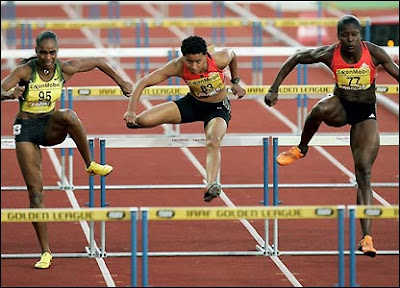
Athletics


Athletics, competitive sport that includes a large number of tests can take place indoors or outdoors. The main disciplines of athletics can be grouped in the following categories: racing, running, release and jumps. The races, which are the most athletic events, ranging from the 50-meter dash (which takes place indoors) until the marathon race, covering 42.195 kilometers. In the United States and Britain are expressing distances in miles, but from 1976 to official records, only recognized metric distances (except for the mile race). In Europe and the Olympics, the distances are always expressed in meters.

100 meters, Sydney 2000The Athletics is the Olympic sport of excellence and the expectation is that more in the Olympics, their tests are performed in the Olympic Stadium and some away from it. Formerly tests Athletics were held in the early rounds of the games but now vie in the last 8 days, matching the end of the marathon ceremonyclosure.


The sport Olympic program consists of the following tests: speed, jumping, combined circuit and release, in total 24 tests are vying male and 20 female in the athletics there is currently no limit of participants as in other sports.

The meetings of outdoor athletics are usually held in a stage in which the central space is a clue, whose floor is ash, clay or synthetic material. The usual length of the runway is 400 m, has an oval shape, with two lines and two curves. Most of the shoots and jumps (called test field) occur in the zone inside the oval. There are disciplines special, as the decathlon (exclusively male), which consists of five tests track and field five, and heptalon (female only), which consists of four tests field and three runs.

Etiquetas:
Athletics

0
comentarios

Diving suits, Sports Diving


The diving suits are essential for dives in waters are warm and where the temperature is not the same as that of the body (32 º C). They offer protection and thermal comfort allowing the diver to remain long enough in the depths.

*Types of diving suits

Existing materials are varied, since neoprene lycra until you can find lots of wetsuits.

With such a diver looking for does not go to extremes such as hypothermia, so it must choose the appropriate attire for water temperature and the activity performed.


*Wet suits

This type is called a wet suit, as between the skin and the inside of the suit creates a water film to come into direct contact with the body unable to afford their heat insulating the cold outside.

According to the temperature of water have different thicknesses, from 2 to 8 mm.It is essential that clothes will stick to the body to the water film is created to achieve warm.


* semi-dry suits

This type of suit was designed to immerse in cold water, so its minimum thickness is 7 mm.

The hood and boots are part of the suit, unlike the previous ones that usually come in separate parts.


* Dry suits
This type of dress means excellence in thermal protection and security. His material is designed to insulate the diver from the colder waters of the polluted well.

The main difference is that the wet to avoid cold water using air as an insulator. This can be a problem because it creates buoyancy, which makes it necessary to learn how to use previously.

Inflation has a mechanism that enters the air that insulates the body from the cold, and it requires the help of a partner to wear it.

The materials used in their manufacture are pressed neoprene and neoprene membrane.


Neoprene pressing

- Shock resistant
- Sticks to the body to perfection
- Excellent thermal insulation
- Limiting the mobility of the diver


Neoprene Diaphragm

- Allows more mobility by being lighter
- Less isolation
- Used with some clothes

Etiquetas:
Diving suits, Sports Diving


Extreme bungee jumping


The origins of extreme bungee back to a rite that was practiced in Indian Vanuatu Islands, is still practiced and is the most extreme bungee all.

In this ancient Indian ritual jump from a wooden platform that has about 30 feet high, bound with ropes made of cane base. The difference with the modern bungee is what makes it the world's most extreme bungee. The jump they made to ensure a good harvest, but this will be guaranteed if the diver touches the floor with his head. A real crazy!


The modern bungee extreme

The modern bungee extreme beginning 1 April 1979 when four jumpers led by David Kirke jumped from the Clifton Suspension Bridge in Bristol.


*Bungee Extreme

That was the beginning, the four were arrested, but then continued jumping in the U.S., which led to the bungee be disseminated rapidly to the whole world.

To practice bungee jumping is necessary to comply with a list of measures security and possess the necessary equipment. Bungee jumping team is composed of a special harness, a bumper padding and a set of bindings, which control the fall and give a braking progressive.

The elastic cord is capable of supporting up to a ton of weight through its conformation thousand natural latex strips interwoven with silicon oxide zinc and additive depletion.

There are now many centers around the world for the practice this extreme sport. Account with important U.S. institutions and Spain each new day adds to the delight of his followers.

The advanced growth in the number of adherents is spectacular, so it is detecting growth also accelerated bungee extreme centers monitored by professionals who guide beginners.

So think no more, lives. If you are the typical adventurer needs risky download all your adrenaline and anger and go to a shopping experience bungee jumping. The mixed feelings make you feel like never'll spend in a matter of seconds fear, nervousness, euphoria, and suddenly begin to experience a high degree of peace and relaxation.

An experience that you can not ignore, because otherwise we do not blame you.


Swimming


Swimming is the art of stand and move, using your arms and legs, on or under water. Activity can be as playful or as a competitive sport. Because humans do not swim instinctively, swimming is a skill that must be learned. Unlike other land animals given impetus in the water, in what is essentially a way of walking, humans have had to develop a series of strokes and body movements that propel him into the water with power and speed. In these movements and styles behind the evolution of competitive swimming as a sport.

Swimming can be practiced in any type of enclosure large enough water to allow free movement and it is not too cold, hot or turbulent. The currents and tides can be dangerous, but also pose a challenge to demonstrate the strength and value of the swimmers, as is apparent with the many successful attempts to cross the Channel.

Swimming was a sport highly esteemed in the ancient civilizations of Greece and Rome, especially as a training method for warriors. In Japan and competitions were held in the first century BC However, during the Middle Ages in Europe the practice was almost forgotten, as the water immersion was associated with continued disease epidemics of the time. By the nineteenth century and this bias disappeared, and in the twentieth, swimming has come to regard a valuable system of physical therapy and exercise is generally more beneficial than exists. No other exercise use many muscles of the body and so intensely. Moreover, increased influx of swimmers and the best techniques of construction and heating, have greatly increased the number of outdoor public swimming pools and decks around the world. The private pool, which was once a sign of exceptional privilege, it is increasingly common.


Techniques


The main obstacle to learning to swim is the fear of water or nervousness, which causes muscle tension. Much has been done on developing methods to reduce this psychological barrier. They often begin to teach very young children. While you can teach older people, the sooner learn to swim the individual, the easier it is. Teaching swimming is important to learn to coordinate the movements of hands and legs with breathing. Their learning has been incorporated into the curricula of schools in many parts of the world. During World War II teaching techniques were developed for large groups, teaching courses for troops as part of their training for combat.


There are five recognized swimming strokes, which have been refined since the late nineteenth century. These are: front crawl (also called freestyle because you can choose in freestyle competitions), the first version gave the English swimmer John Arthur Trudgen in the 1870s, back, who used it first U.S. swimmer Harry Hebner in the 1912 Olympics, breaststroke, the oldest style, known since the seventeenth century; butterfly, developed in the 1930s by Henry Myers and other American swimmers and recognition in 1950 as an independent style, and stroke in cost, basic style in the early years of competition, but now only used in non-competitive swimming.

1. Crol


In this style, one arm of the swimmer moves through the air with your palm down ready to enter the water, and elbow relaxed, while the other arm goes under the water. The legs move according to what in recent years has evolved as a kick oscillating reciprocating hips up and down with your legs relaxed, feet and toes inward to a point. For each complete cycle of the arms are held from two to eight kicks oscillating. This style is very important to breathe properly. You can take a full breath for each cycle of arms, inhaling through the mouth to turn his head to one side when you move the arm and then exhaling underwater when the arm moves back.


2. Fathom


In this style, the swimmer floats facedown, with arms pointing forward, palms around, and executes the following sequence of horizontal movements: open arms back to get in line with your shoulders, always above or below the water surface. They shrink the legs to bring them closer to the body, knees and toes out, and then stretched with a drive while the arms back to starting point at which starts the cycle again. The swimmer breathes underwater. The strokes must be lateral, not vertical. This is a very important point discussed in competitive swimming.


3. Butterfly

In the variant known as butterfly breaststroke, both arms together in front are carried over the water and then back at the same time. The arm movement is continuous and always accompanied by an undulating movement of her hips. The kick, called Dolphin, is a sharp downward movement and feet together.


4. Back


This style is similar to front crawl, but the swimmer floats back into the water. The sequence of movements is an alternative: one arm in the air with the palms outward flowing out from under the leg, while the other drives the body in the water. Also used here swinging kick.


5. Stroke side


It has many uses in non-competitive swimming. It is very useful as a salvage technique. Moreover, as it does not require much physical effort as other styles, suitable for long distances. It is also popular for recreational swimming because the head always stays above water. The swimmer floats on one of the two sides of his body and moves his arms alternately. The arm that is under water gives impetus to the head height, rises and returns to the waist, the arm is crossed over her waist and then gives impetus to his chest again. The legs are opened slowly and then contract sharply, giving a momentum kick, scissor, before stretching at all.


Competition


The swimming competition includes individual and team tests. In mixed races using the four styles of racing-crawl, back, breaststroke and butterfly in any order for individuals and another for teams. In tests of relay teams consist of four swimmers who take turns, with total time determines the winning team.


In international competitions the length of the tests between 50 and 1,500 meters. The world records are recognized only when set in pools of 50 m in length. Competition has become so strong that it has been necessary to define very precise rules for the various styles and to regulate the physical size and shape of the pool, equipment type, demarcation of the streets, water temperature, all important elements determining the performance. Electronic devices for measuring and timing have almost replaced the judges and timekeepers in the swimming events.


History


In modern competitive swimming was introduced in Britain in the late eighteenth century. The first such organization was the National Swimming Society, founded in London in 1837. In 1869 he created the Metropolitan Swimming Clubs Association, which later became the Amateur Swimming Association (ASA). The first national champion was Tom Morris, who won a mile race on the Thames in 1869. In the late nineteenth century, competitive swimming was being established in Australia and New Zealand and several European countries had already established their respective federations. In the U.S., the amateur clubs began to hold competitions in the 1870s.

The first Olympics of the modern era, held in Athens in 1896, also included swimming. In 1908 he organized the Federation Internationale de Natation Amateur for racing fans to celebrate. The women's competition was first included in the 1912 Olympics. International competitions have been sponsored by European amateur clubs to swimming since the late nineteenth century. However, until the 1920s, these competitions were not defined on a fixed regular basis. Britain had created some competition between member nations of the British Empire before 1910. The first official game of the British Empire, where the swimming was a major component, were held in Canada in 1930. Swimming now plays a key role in several other international competitions, the most prominent Pan American Games and Asian competitions, and Mediterranean.

The World Championship was first held in 1973 and is held every four years. The European Championship was first held in Budapest in 1926, there were five competitions between 1927 and 1947, from 1950 to 1974 he played with four-year intervals since 1981, take place every two years. There was a World Cup in 1979 when the U.S. won the competition in both male and female. The European Cup was first held in 1969 and since then has held every two years.

Swimming is a sport where competition is mainly focused on time. That's why in recent decades swimmers have focused on the sole purpose of breaking records. What once were surprising speed records of competitors from the likes of Duke Paoa Kahanamoku, Johnny Weissmuller, Buster Crabbe Clarence, Mark Spitz, David Wilkie, Shane Elizabeth Gould and Martin Lopez-Zubero, among others, have already been or will be overshadowed by new superlatives. Similarly, are continually breaking records set by distance and endurance marathon swimmers, such as the American swimmer Gertrude Caroline Ederle, the first woman to swim the Channel. Consequently, the gap between men and women in competitive swimming have been greatly reduced; has decreased the age at which swimmers can compete successfully and have not yet reached the physical limits of the specialty.


All about Spinning


Maybe you've heard about spinning and you have not yet quite clear what it is. However, in urban women tell you all about this discipline.

Spinning is a physical activity that develops on a stationary bike or static, without moving an inch of the place. However, spinning is hardly static: aerobic activity is very strong and not suitable for everyone.

A spinning class consists of a route "virtual" bike, which will be accompanied by special music that we will mark the different rhythms that we will continue pedaling.


In one class we will go through stages of intense, rapid cycling, as well as slow, rhythmic pedaling. It all depends on the music that will carry us, and the trainer's instructions.


According to experts, spinning not only promotes cardiovascular health, but also promotes concentration and self-improvement.


If you are interested in spinning, check on your gym if you can practice and if your physical conditions are optimal to do so. Spinning is not recommended for people with history of heart disease or joint problems because, at times, the pedal is too intense. Check with your doctor to see if spinning is suitable for you.


Cyclism - BMX tricks


There are a lot of bmx tricks, the same that have names of its own and is the way that followers and fans of this sport, known them all. In the whole wolrd, Dave Mirra is known as the biggest exponent in acrobatics and bmx tricks.


In spite of starting in the skateboard world, this U.S.A. native, became famous with the bmx, because he made 18 medals in the X-Games (the most popular championship in extreme sports). Is because this reason he is considered the best sportman in the history of bmx bikes.

Bunny hop: the most well known jump of BMX, it consists in lift the front wheel and then the back one.


Nollie: the back wheel is lifted in first instance, tucking in the arms, and then the same are stretched for lifting the body, and tucking them again for the bike gets high.

Fakie: it consists in going against the natural way, backwards, for this is necessary to pedal backwards.

Rollback: Is used for spinning 180 degrees in the air. 360: the idea is to perfor a spin upon yourseld, but is not compared with the 180 one, because it has a different performance itself.

Manual: this trick consists in moving in a balanced wayin the back wheel but without using the pedals, is only taken with the body weight. No manual: is all the opposite to manual, the idea is to move forwards to the front wheel.


Tailwhip: this acrobacy consists in spin the bike to 360 degrees, having steering wheel set.

Barspin: ou have to spin 360 degrees.

X-Up: Of similar carachteristics to barspin, but the manillar only spins 180 degrees.

Footjam: The idea is to support the front feet on the front wheel, and in this way induce the bike to do some acrobacy.

Tabletop: the idea is to try the bike folds to one side.


No hand/foot: No hand is to leave the hands of the manillar grabbing it with the kneels, the No foot is to lose the feet of pedals and to perform the trick you think convenient.


One hand - foot: the idea is to lose one hand or foot, and from there perform any tricl.

Backflip: it consists in spin backwards, is considerated one of the bmx tricks more difficult to realize.

Turdown: The idea is to stretch the legs the more we can and in this way cross the handle backwards.

Etiquetas:
Cyclism - BMX tricks


Windsurfing technique


Find healthy dessert recipes and ideas, for having a nicer diet without gaining extra weight. Frozen yogurt, healthy chocolate, puddin, ice cream and more! Enjoy Healthiest desserts


What sports are?


Sport is an activity that is governed by a set of rules or customs and for exercise, pleasure, or competition. Sports commonly refer to activities where the physical capabilities of the competitor are the sole or primary determinant of winning or losing, but the term is also used to include activities such as mind sports and motor sports where mental acuity or equipment quality are major factors. Sport is commonly defined as an organized, competitive and skillful physical activity requiring commitment and fair play.

Our most popular sports are:

Martial Arts
Boxing
Cycling
Horse Racing
Rugby
Skiing
Surfing
Snowboarding
Football
Basketball
World soccer
Tennis
Golf
Swimming

FRIENDS

Calories vs. Cardio

Calories vs. Cardio


How long does it really take to work off the calories in the foods you eat? We'll show you the time before you do the crime.

You already know that scarfing down a bacon cheeseburger and fries will cost you a couple thousand calories — and a couple hours of cardio at the gym. But you may not realize that any food, no matter how healthy it seems, becomes instantly unhealthy once you eat too much of it. Here are some surprising — and not so surprising — caloric offenders, and exactly the price you'll pay in sweat.


CRIME: White cheddar rice cakes

Exhibit A: 45 calories, 0.5 g fat, 160 mg sodium per rice cake
Exhibit B: Can you resist the temptation to eat more than one? How about more than four? The more you chomp on these airy snacks, the higher the calories climb, but do you feel any fuller? Yeah, didn't think so.
SENTENCE: 10 minutes on the stair climber for every two rice cakes
CRIME: Deep-dish pizza

Exhibit A: 220 calories, 7 g fat, 240 mg sodium per slice
Exhibit B: Add extra cheese, pepperoni, sausage and ham for an extra 120 calories per slice. And let's be frank — are you going to stop at just one?
SENTENCE: 37 minutes on the stair climber for each overloaded slice
Burn-a-Thon!


Did you know that reducing your body weight by just 5% to 10% significantly lowers your risk of developing type 2 diabetes? That's why on November 7, in honor of American Diabetes Month, Gold's Gyms across the globe will open their doors to members and nonmembers alike. The goal is to work together to burn off 180 million calories — the equivalent of 50,000 pounds of fat — to help us do a 180 on this deadly disease. Ready to do your part? The average person burns about 500 calories in 45 minutes of cardio!

* Forward this article to friends
* Download our calorie-burn chart to see how you can contribute
* Log on to the American Diabetes Association's website to donate now


CRIME: Mini pretzels

Exhibit A: 110 calories, 0 g fat, 250 mg sodium per one-ounce serving
Exhibit B: Double dipping is double trouble, especially since a single serving contains 10% of the recommended daily sodium intake.
SENTENCE: 20 minutes of brisk walking for every serving you eat
CRIME: Large blended coffee with vanilla shot

Exhibit A: 440 calories, 4.5 g fat, 330 mg sodium
Exhibit B: Top it off with whipped cream for an additional 120 calories and 11 grams of fat.
SENTENCE: 37 minutes on the elliptical trainer
CRIME: Granola

Exhibit A: 210 calories, 6 g fat, 25 mg sodium per half-cup serving
Exhibit B: A half-cup serving is deceptively small. A hearty breakfast bowl can hold anywhere from one to two cups of cereal, which is at least double the recommended portion size and up to 840 calories. Use nonfat or low-fat milk to minimize the damage.
SENTENCE: 56 minutes on the elliptical trainer
CRIME: Multigrain bagel

Exhibit A: 400 calories, 9 g fat, 600 mg sodium
Exhibit B: Who gets a bagel without cream cheese? Add a schmear of reduced-fat strawberry cream cheese for an extra 150 calories and 10 grams of fat.
SENTENCE: 52 minutes of intense circuit training
CRIME: Six-inch deli meat sub sandwich

Exhibit A: 410 calories, 16 g fat, 1,450 mg sodium
Exhibit B: Maybe it's not the worst thing you can eat, but it's definitely not the best. The values above don't reflect any of the tasty fixin's, like mayonnaise, oil and vinegar, and fancy flavored dressings. Depending on how heavy-handed your server is with the squeeze bottle, you could be squirting another 200 calories on that sub. Oh, and over 50% of daily recommended sodium intake.
SENTENCE: 1 hour, 6 minutes on the row machine
CRIME: Cobb salad

Exhibit A: 708 calories, 55 g fat, 1,328 mg sodium
Exhibit B: We haven't gotten to the dressing yet. How about reduced-fat vinaigrette? Boom! 100 calories.
SENTENCE: 1 hour, 29 minutes on the stationary bike
CRIME: Fat-free soft-serve vanilla frozen yogurt

Exhibit A: 110 calories, 0 g fat, 65 mg sodium per ½ cup serving
Exhibit B: On paper, this sweet treat doesn't look so bad, until you realize that a size "regular" holds more than two and a half servings! Order the extra large for the equivalent of 4.6 servings in one tiny Styrofoam cup. Not to mention that fat-free desserts tend to overdo it on sugar to compensate for taste. You may end up consuming the same amount of sugar as found in a bottle of soda. Sugary toppings will only make matters worse.
SENTENCE: 1 hour, 30 minutes — the equivalent of 4.5 miles, or 18 laps around the track — of walking
CRIME: Honey BBQ wings (10)

Exhibit A: 90 calories, 5 g fat, 260 mg sodium per wing
Exhibit B: A tiny serving of zesty ranch or blue cheese dressing tacks on an additional 140 calories.
SENTENCE: 1 hour, 33 minutes of jogging
CRIME: Bacon cheeseburger

Exhibit A: 790 calories, 39 g of fat, 2,070 mg sodium
Exhibit B: You probably also ordered a medium fries (380 calories, 19 g fat) and a medium soda (210 calories) for a heart-stopping total of 1,380 calories.
SENTENCE: 1 hour, 32 minutes on the elliptical trainer
CRIME: Chili cheese fries

Exhibit A: 1,920 calories, 147 g fat, 3,570 mg sodium
Exhibit B: The prosecution rests.
SENTENCE: 2 hours, 25 minutes of full-speed running


Calories burned during exercise is affected by body weight, intensity of workout, conditioning level and metabolism. Calories burned per hour are listed below for the example body weights of 130, 155 and 190 pounds.
Calories Burned During Exercise
Activity (1 hour)
130lbs
155lbs
190lbs
Aerobics, general
Aerobics, high impact
Aerobics, low impact
Archery (nonhunting)
Automobile repair
Backpacking, general
Badminton, competitive
Badminton, social, general
Basketball, game
Basketball, nongame, general
Basketball, officiating
Basketball, shooting baskets
Basketball, wheelchair
Bicycling, <10mph,>20mph, racing
Bicycling, 10-11.9mph, light
Bicycling, 12-13.9mph, moderate
Bicycling, 14-15.9mph, vigorous
Bicycling, 16-19mph, very fast, racing
Bicycling, BMX or mountain
Bicycling, stationary, general
Bicycling, stationary, light
Bicycling, stationary, moderate
Bicycling, stationary, very light
Bicycling, stationary, very vigorous
Bicycling, stationary, vigorous
Billiards
Bowling
Boxing, in ring, general
Boxing, punching bag
Boxing, sparring
Broomball
Calisthenics, home, vigorous
Calisthenics, home, light/moderate
Canoeing, on camping trip
Canoeing, rowing, >6 mph, vigorous
Canoeing, rowing, crewing, competition
Canoeing, rowing, light
Canoeing, rowing, moderate
Carpentry, general
Carrying heavy loads, such as bricks
Child care: sitting/kneeling-dressing
Child care: standing-dressing, feeding
Circuit training, general
Cleaning, heavy, vigorous
Cleaning, house, general
Cleaning, light, moderate
Coaching: football, soccer, basketball
Construction, outside, remodeling
Cooking or food preparation
Cricket (batting, bowling)
Croquet
Curling
Dancing, aerobic, ballet or modern
Dancing, ballroom, fast
Dancing, ballroom, slow
Dancing, general
Darts, wall or lawn
Diving, springboard or platform
Electrical work, plumbing
Farming, baling hay, cleaning barn
Farming, milking by hand
Farming, shoveling grain
Fencing
Fishing from boat, sitting
Fishing from river bank, standing
Fishing in stream, in waders
Fishing, general
Fishing, ice, sitting
Football or baseball, playing catch
Football, competitive
Football, touch, flag, general
Frisbee playing, general
Frisbee, ultimate
Gardening, general
Golf, carrying clubs
Golf, general
Golf, miniature or driving range
Golf, pulling clubs
Golf, using power cart
Gymnastics, general
Hacky sack
Handball, general
Handball, team
Health club exercise, general
Hiking, cross country
Hockey, field
Hockey, ice
Horse grooming
Horse racing, galloping
Horseback riding, general
Horseback riding, trotting
Horseback riding, walking
Hunting, general
Jai alai
Jogging, general
Judo, karate, kick boxing, tae kwan do
Kayaking
Kickball
Lacrosse
Marching band, playing instrument
Marching, rapidly, military
Moto-cross
Moving furniture, household
Moving household items-upstairs
Moving household items-carrying
Mowing lawn, general
Mowing lawn, riding mower
Music playing, cello, flute, horn
Music playing, drums
Music playing, guitar, classical (sitting)
Music playing, guitar, rock/roll (stand)
Music playing, piano, organ, violin
Paddleboat
Painting, papering, plastering, scraping
Polo
Pushing or pulling stroller with child
Race walking
Racquetball, casual, general
Racquetball, competitive
Raking lawn
Rock climbing, ascending rock
Rock climbing, rapelling
Rope jumping, fast
Rope jumping, moderate, general
Rope jumping, slow
Rowing, stationary, light
Rowing, stationary, moderate
Rowing, stationary, very vigorous
Rowing, stationary, vigorous
Rugby
Running, 10 mph (6 min mile)
Running, 10.9 mph (5.5 min mile)
Running, 5 mph (12 min mile)
Running, 5.2 mph (11.5 min mile)
Running, 6 mph (10 min mile)
Running, 6.7 mph (9 min mile)
Running, 7 mph (8.5 min mile)
Running, 7.5mph (8 min mile)
Running, 8 mph (7.5 min mile)
Running, 8.6 mph (7 min mile)
Running, 9 mph (6.5 min mile)
Running, cross country
Running, general
Running, in place
Running, on a track, team practice
Running, stairs, up
Running, training, pushing wheelchair
Running, wheeling, general
Sailing, windsurfing, general
Sailing, in competition
Scrubbing floors, on hands and knees
Shoveling snow, by hand
Shuffleboard, lawn bowling
Sitting-playing with child(ren)-light
Skateboarding
Skating, ice, 9 mph or less
Skating, ice, general
Skating, ice, rapidly, > 9 mph
Skating, ice, speed, competitive
Skating, roller
Ski jumping (climb up carrying skis)
Ski machine, general
Skiing, cross-country, racing
Skiing, cross-country, moderate
Skiing, cross-country, slow or light
Skiing, cross-country, uphill, max
Skiing, cross-country, vigorous
Skiing, downhill, light
Skiing, downhill, moderate
Skiing, downhill, vigorous , racing
Skiing, snow, general
Skiing, water
Ski-mobiling, water
Skin diving, scuba diving, general
Sledding, bobsledding, luge
Snorkeling
Snow shoeing
Snowmobiling
Soccer, casual, general
Soccer, competitive
Softball or baseball, fast or slow pitch
Softball, officiating
Squash
Stair-treadmill ergometer, general
Standing-packing/unpacking boxes
Stretching, hatha yoga
Surfing, body or board
Sweeping garage, sidewalk
Swimming laps- fast-vigorous
Swimming laps, freestyle-light
Swimming, backstroke, general
Swimming, breaststroke, general
Swimming, butterfly, general
Swimming, leisurely, general
Swimming, sidestroke, general
Swimming, sychronized
Swimming, treading water, vigorous
Swimming, treading water, moderate
Table tennis, ping pong
Tai chi
Teaching aerobics class
Tennis, doubles
Tennis, general
Tennis, singles
Unicycling
Volleyball, beach
Volleyball, competitive, in gymnasium
Volleyball, noncompetitive
Walk/run-playing with child-moderate
Walk/run-playing with child-vigorous
Walking, 2.0 mph, slow pace
Walking, 3.0 mph, mod. pace
Walking, 3.5 mph, uphill
Walking, 4.0 mph, very brisk pace
Walking, carrying infant or 15-lb load
Walking, grass track
Walking, upstairs
Walking, using crutches
Wallyball, general
Water aerobics, water calisthenics
Water polo
Water volleyball
Weight lifting/body building, vigorous
Weight lifting, light or moderate
Whitewater rafting/kayaking/canoeing

354
413
295
207
177
413
413
266
472
354
413
266
384
236
944
354
472
590
708
502
295
325
413
177
738
620
148
177
708
354
531
413
472
266
236
708
708
177
413
207
472
177
207
472
266
207
148
236
325
148
295
148
236
354
325
177
266
148
177
207
472
177
325
354
148
207
354
236
118
148
531
472
177
207
295
325
236
177
295
207
236
236
708
472
325
354
472
472
354
472
236
384
148
295
708
413
590
295
413
472
236
384
236
354
531
413
325
148
118
236
118
177
148
236
266
472
148
384
413
590
236
649
472
708
590
472
561
413
708
502
590
944
1062
472
531
590
649
679
738
797
826
885
531
472
472
590
885
472
177
177
295
325
354
177
148
295
325
413
531
885
413
413
561
826
472
413
974
531
295
354
472
413
354
413
413
413
295
472
207
413
590
295
354
708
354
207
236
177
236
590
472
472
590
649
354
472
472
590
236
236
236
354
354
413
472
295
472
236
177
236
295
148
207
354
236
207
295
472
236
413
236
590
177
354
177
295
422
493
352
246
211
493
493
317
563
422
493
317
457
281
1126
422
563
704
844
598
352
387
493
211
880
739
176
211
844
422
633
493
563
317
281
844
844
211
493
246
563
211
246
563
317
246
176
281
387
176
352
176
281
422
387
211
317
176
211
246
563
211
387
422
176
246
422
281
141
176
633
563
211
246
352
387
281
211
352
246
281
281
844
563
387
422
563
563
422
563
281
457
176
352
844
493
704
352
493
563
281
457
281
422
633
493
387
176
141
281
141
211
176
281
317
563
176
457
493
704
281
774
563
844
704
563
669
493
844
598
704
1126
1267
563
633
704
774
809
880
950
985
1056
633
563
563
704
1056
563
211
211
352
387
422
211
176
352
387
493
633
1056
493
493
669
985
563
493
1161
633
352
422
563
493
422
493
493
493
352
563
246
493
704
352
422
844
422
246
281
211
281
704
563
563
704
774
422
563
563
704
281
281
281
422
422
493
563
352
563
281
211
281
352
176
246
422
281
246
352
563
281
493
281
704
211
422
211
352
518
604
431
302
259
604
604
388
690
518
604
388
561
345
1380
518
690
863
1035
733
431
474
604
259
1078
906
216
259
1035
518
776
604
690
388
345
1035
1035
259
604
302
690
259
302
690
388
302
216
345
474
216
431
216
345
518
474
259
388
216
259
302
690
259
474
518
216
302
518
345
173
216
776
690
259
302
431
474
345
259
431
302
345
345
1035
690
474
518
690
690
518
690
345
561
216
431
1035
604
863
431
604
690
345
561
345
518
776
604
474
216
173
345
173
259
216
345
388
690
216
561
604
863
345
949
690
1035
863
690
819
604
1035
733
863
1380
1553
690
776
863
949
992
1078
1165
1208
1294
776
690
690
863
1294
690
259
259
431
474
518
259
216
431
474
604
776
1294
604
604
819
1208
690
604
1423
776
431
518
690
604
518
604
604
604
431
690
302
604
863
431
518
1035
518
302
345
259
345
863
690
690
863
949
518
690
690
863
345
345
345
518
518
604
690
431
690
345
259
345
431
216
302
518
345
302
431
690
345
604
345
863
259
518
259
431
FRIENDS